Inside Saint Martin de Tours: The Mother Church of the Acadians in St. Martinville
Share This Post
This post may contain affiliate links, which means I may earn a small commission from purchased products at no additional cost to you.
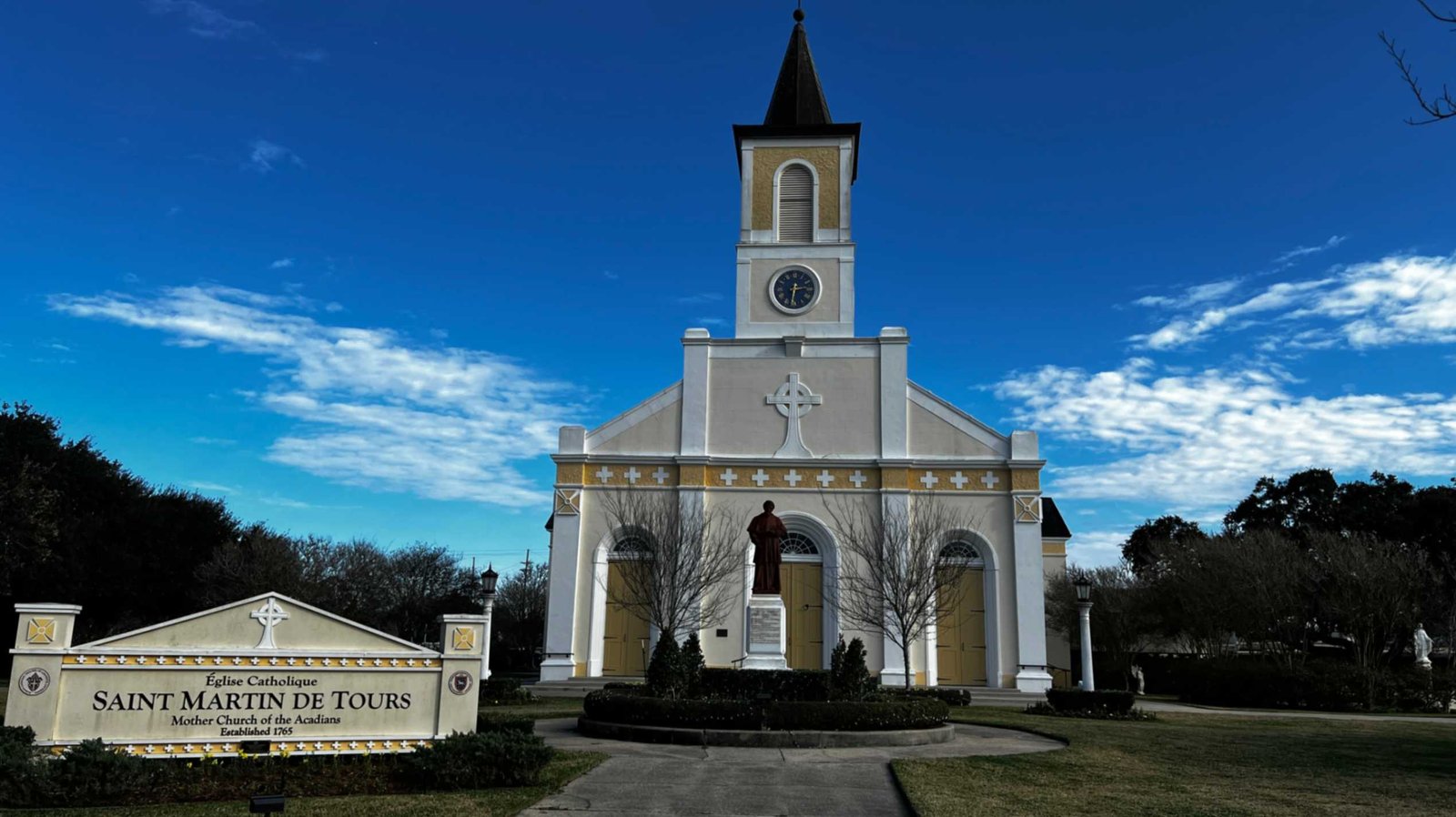
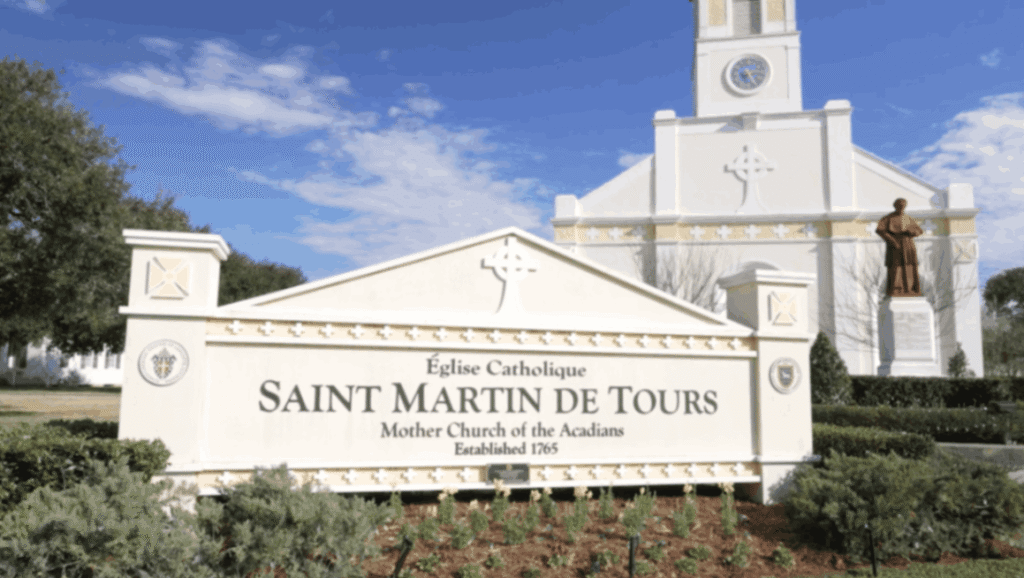
Saint Martin de Tours Catholic Church in St. Martinville is one of the oldest Catholic churches in America. The sign out front says Mother Church of the Acadians, founded in 1765.
The monument sign at Saint Martin de Tours Catholic Church.
I am a LeBlanc, a Cajun by birth. I thought I really understood my family tree and my family’s story until I walked inside this church. Being here taught me a lot.
St. Martin De Tours exterior view.
This church is a cornerstone of not only St. Martin Parish. It is the glue that kept the Cajun culture and community alive. It gave birth not only to the name but the actual culture of the whole parish.
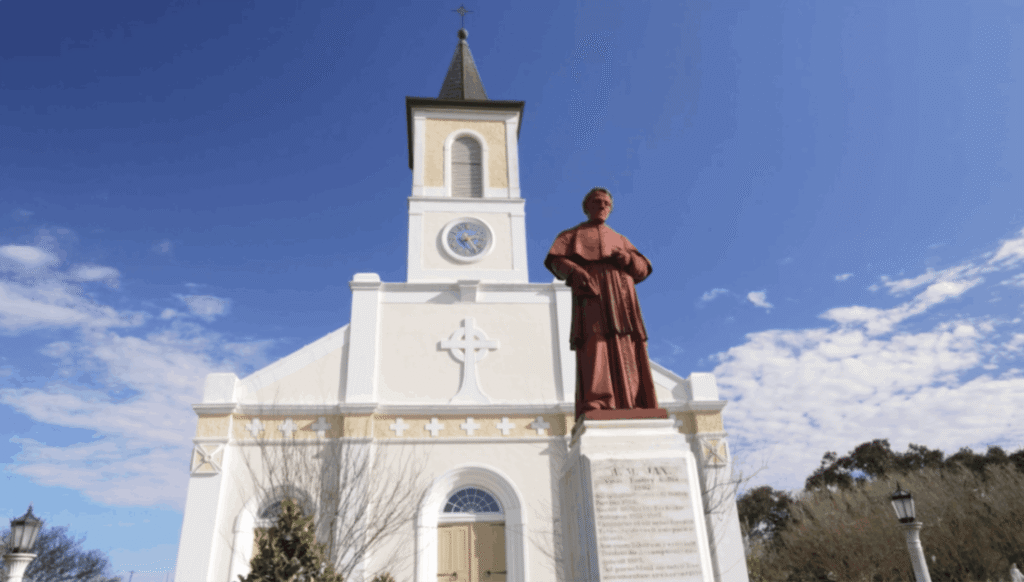
The historic St. Martin de Tours Catholic Church, founded in 1765 and known as the ‘Mother Church of the Acadians,’ featuring the monument to Father Ange Marie Jan.
Three historic buildings sit on the property. The current church structure was enlarged over the centuries and was built in 1836. The church is flanked on the right by a two-story rectory called the Presbytere and a two-story parish hall on the left, both buildings predate the Civil War.
All three historic buildings face a large grass covered tree shaded park. In front of the church stands Father Jan, an early pastor. In front of the rectory stands a statue of Saint Martin of Tours, the patron of the town and the parish. In front of the parish hall stands a statue of a Native American from the Attakapas Nation.
Table of Contents
The Church That Gave Birth to a Community
I sat down with Father Jason Vidrine, who pronounces his name “V-drine”.
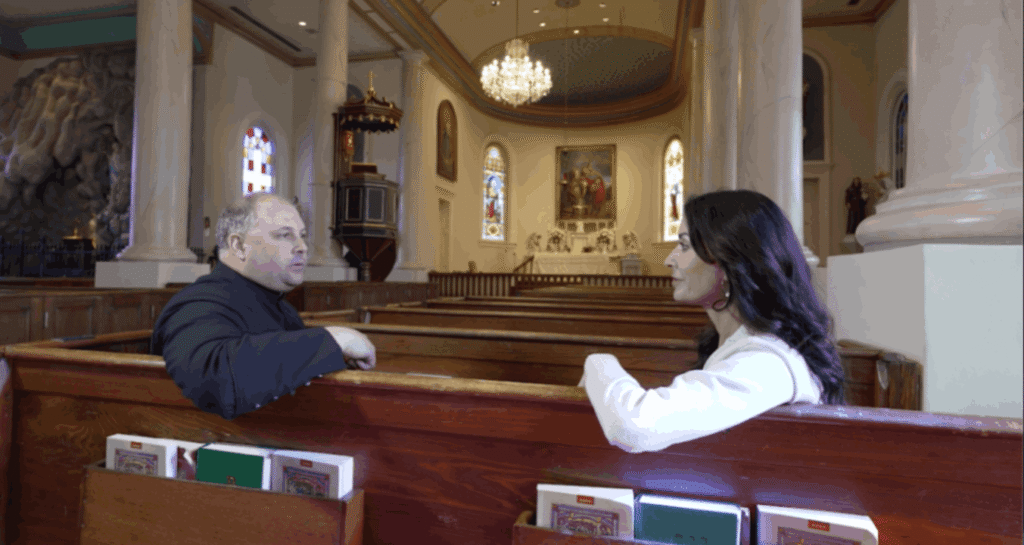
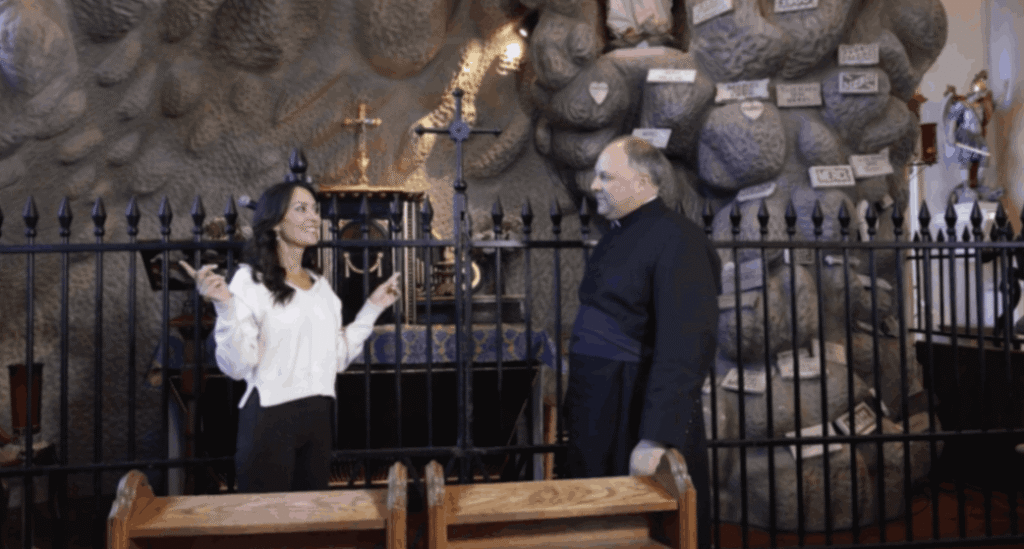
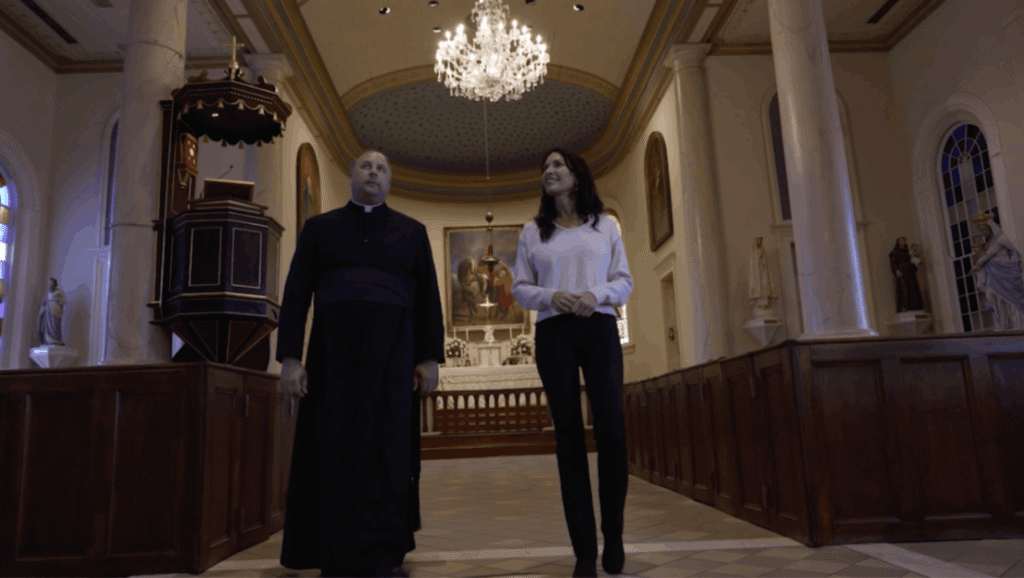
Host Karen LeBlanc interviews Father Jason Vidrine inside the historic St. Martin de Tours Church in Saint Martinville, Louisiana.
When the Acadians arrived after being brutally deported from Acadia, with their fearless leader, Beausoleil Broussard, they erected a church here. And it is the church that gave birth to the community. The community that gave birth to the parish. — Father Jason Vidrine
After the deportation of the Acadians, there were a few who arrived along the river south of Baton Rouge in the 1750s. But the largest groups took about ten years to get here, and they resettled from New Orleans to the banks of Bayou Teche, led by a priest named Father Jean-Francois. They arrived in May 1765, coming to New Orleans around Easter, and it took about a month to come by bayou.
St. Martin de Tours was placed on the National Register of Historic Places in 1972 and is recognized as the Mother Church of the Acadians.
The original Greek Revival church building was designed in 1836 by Pierre Benjamin Buisson, a well known architect from New Orleans. Construction began in 1836 and spanned seven years, finally being completed in 1844.
The Weight of Legacy
I looked around the sanctuary and asked Father Vidrine whether, as priest here with so much history, he feels the weight and the responsibility of its legacy.
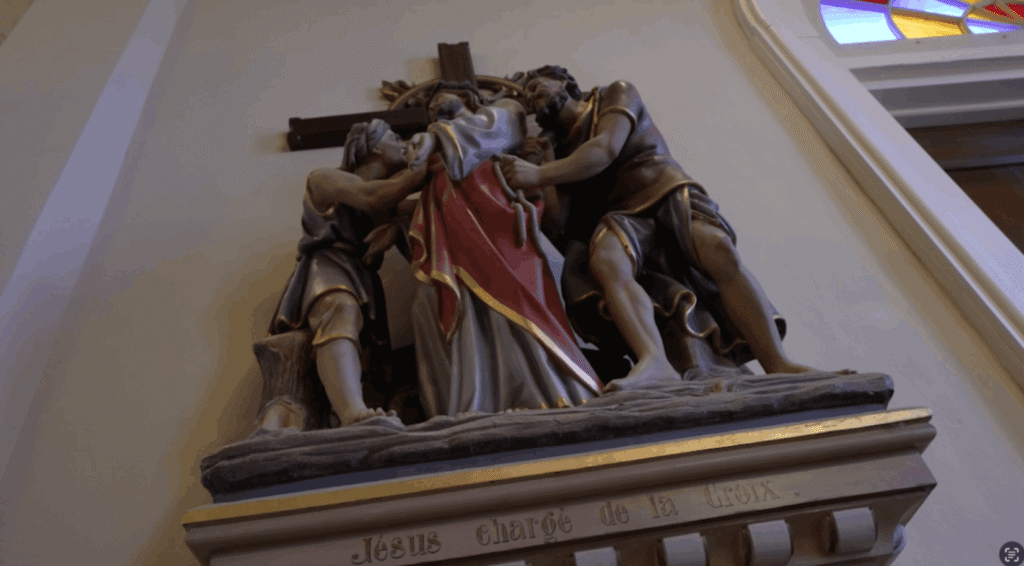
One of the historic Stations of the Cross at St. Martin de Tours, titled in French to honor the parish’s Acadian roots. These detailed sculptures have been a part of the church’s interior for over a century.
I do, for sure. I have always enjoyed history. I have always enjoyed genealogy. I have always enjoyed the fascination of our culture itself. And so to be here at the epicenter of it all, to climb the pulpit here in the church and preach the gospel to form new families in that long line of the faith, is just a tremendous gift for sure. — Father Jason Vidrine
You really do feel the weight of history in this place.
Why Faith Mattered
I asked Father Vidrine what role faith played in Acadian culture and community.
I do not think you can understand the Acadian people or culture without the Catholic faith. First of all, it was the faith that was the primary reason that they got deported. They did not want to be subjects of an English king that was Anglican. — Father Jason Vidrine
Most of the life of the Acadian people from daylight to sunset was based on the faith. The festivals they had, the practices of the family, the farm, everything was based on the faith. — Father Jason Vidrine
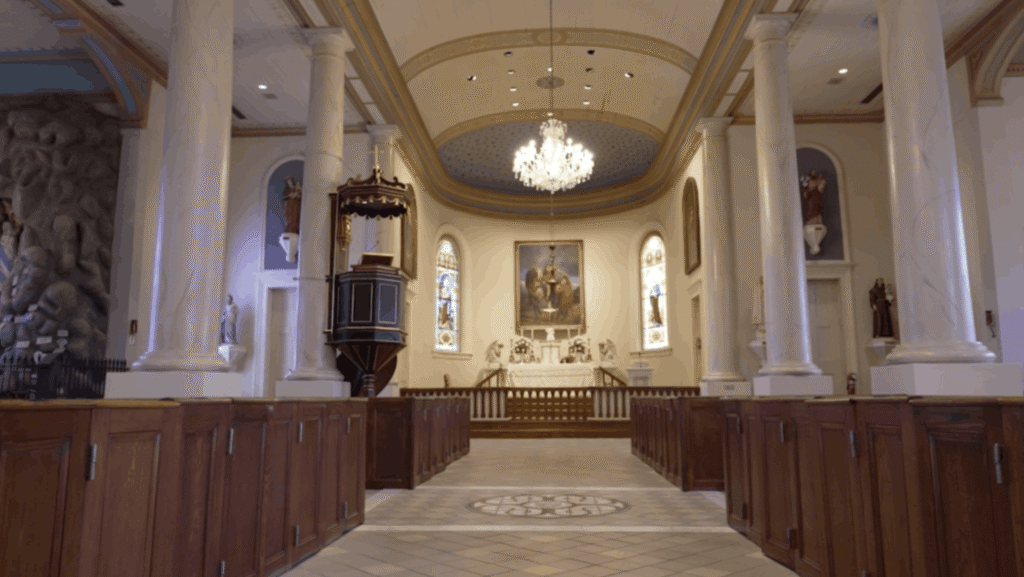
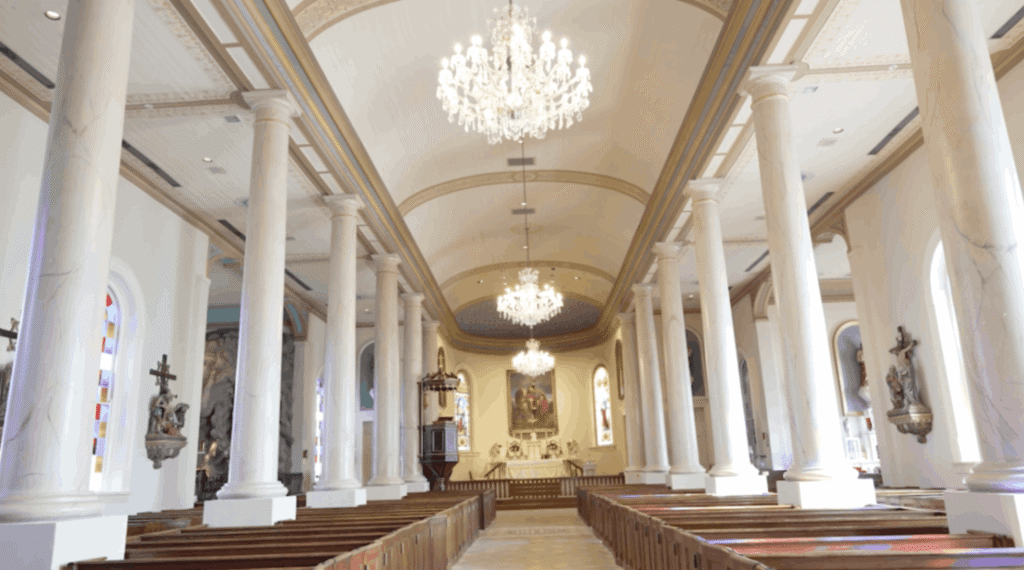
The elegant interior of St. Martin de Tours Church in Saint Martinville, Louisiana, showing the traditional Roman basilica layout and the 19th-century crystal chandelier that serves as a centerpiece of the nave.
So one of the reasons why they were deported was for their faith. And they brought that with them. And it became the primary glue that held the family and the culture together. All of the festivals, all of the celebrations throughout the year revolved around the feast of the church. — Father Jason Vidrine
I wrote that down in my notebook.
And it is that faith that has been passed down now for over 250 years, almost 300 years, that still makes St. Martin Parish and especially St. Martin de Tours, St. Martinville, a place of tremendous faith, tremendous celebration of the faith. But faith that makes it possible. — Father Jason Vidrine
A Simple But Noble Beauty
I told Father Vidrine that the church is a place of holiness but architecturally very beautiful.
The grand interior of the ‘Mother Church of the Acadians,’ St. Martin de Tours, featuring its signature 1840s Roman basilica architecture, imported crystal chandeliers, and classical Doric columns.
There is a simple but noble beauty to it. It is designed in the old Roman basilica style. Many of the statues point to France, point to the French heritage, point to the Catholic faith as received through the French. — Father Jason Vidrine
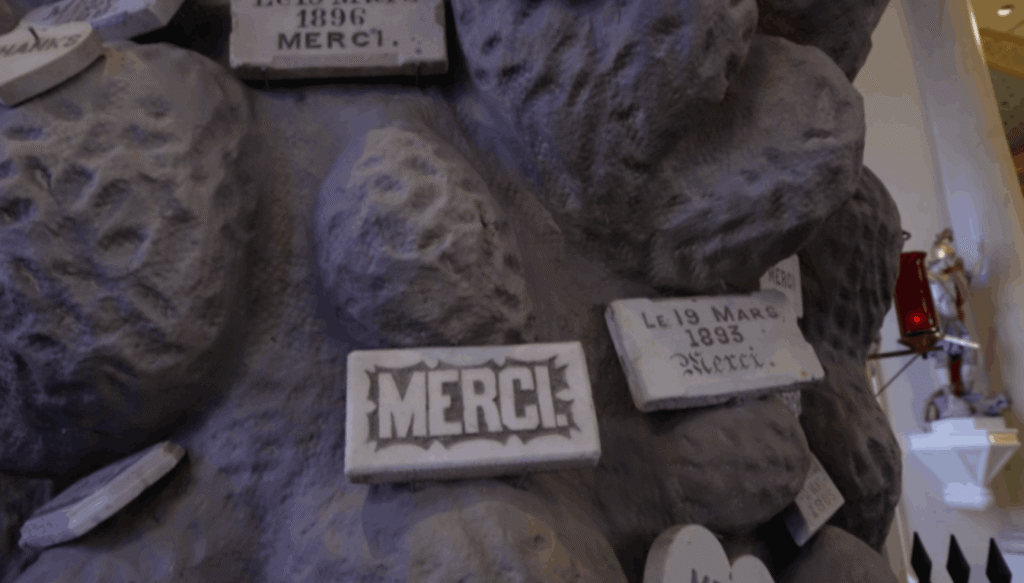
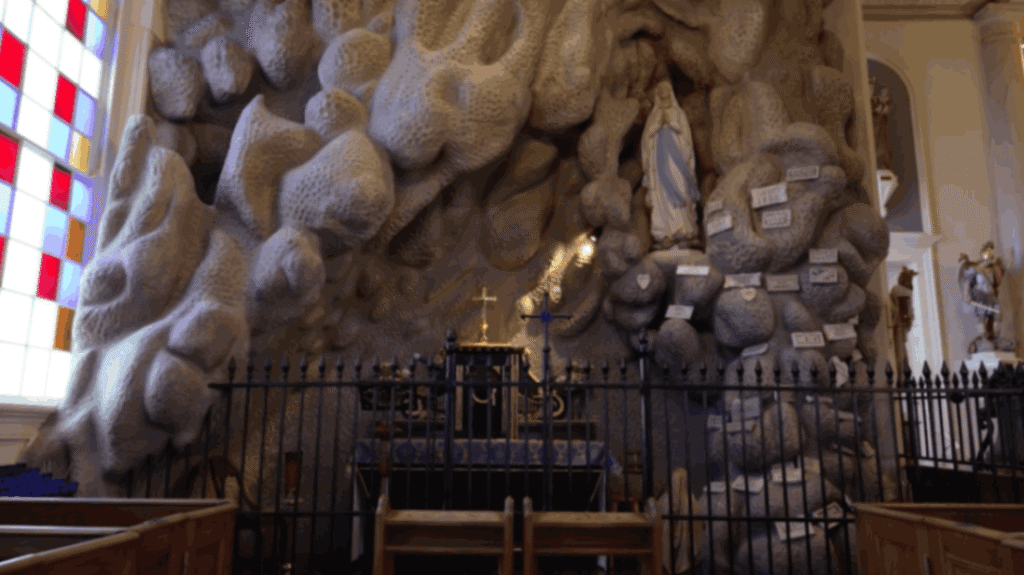
Handcrafted ‘Merci’ (Thank You) plaques adorn the Lourdes Grotto at St. Martin de Tours. These ex-voto offerings, some dating back to the late 19th century, were placed by parishioners to express gratitude for answered prayers and miracles.
While it is not as beautiful as maybe many of the basilicas in the old world like France or Italy or Germany, there is a beauty to it here in the New World that was possible here in Louisiana. — Father Jason Vidrine
A deep, deep history contributed to the evolution of a whole culture.
In South Louisiana, if you really want to look at a larger picture, you can go to any place in America and find anything American. But within America, there is this South Louisiana that is the tension of the world.
What Visitors Should Know
I asked Father Vidrine whether, for visitors passing through St. Martinville, he would say stop, stay a while, and come visit the church.
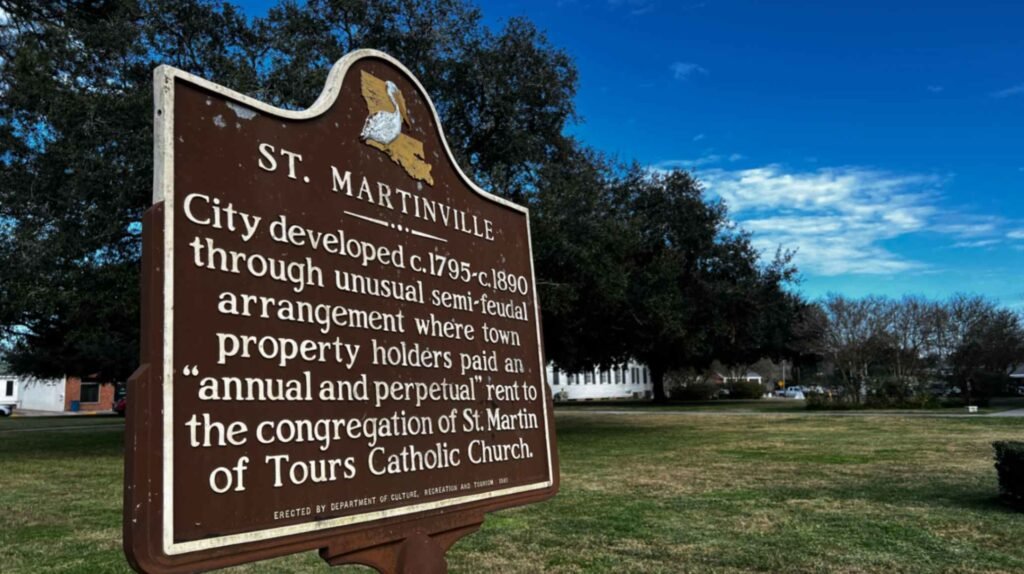
Historical marker detailing the origins of St. Martinville, Louisiana.
Most definitely. There is a great tangible experience of our culture here at St. Martin of Tours and St. Martin Parish. Certainly there are places to stay. There is great food to eat. There is great music to listen to. And there is also just the natural beauty of the bayou and the area that one would certainly want to enjoy. — Father Jason Vidrine
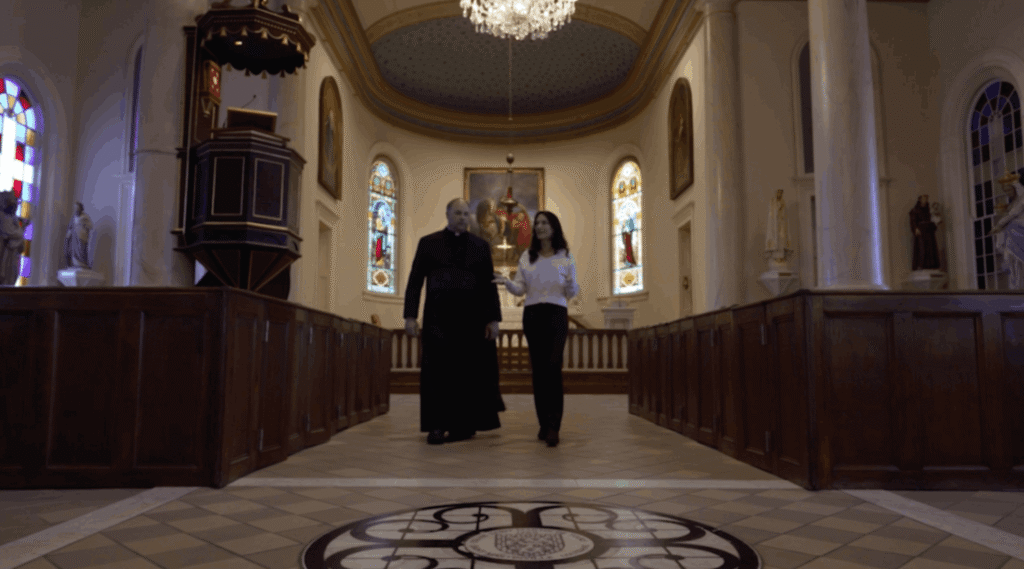
Host Karen LeBlanc and Father Jason Vidrine walk through the historic nave of St. Martin de Tours.
Above the main altar hangs a painting of St. Martin giving aid to a poor beggar. St. Martin was born in Hungary in 315 as the son of a Roman military tribune. He became a soldier and met a beggar while on route to battle and cut his cloak in half giving half to the beggar.
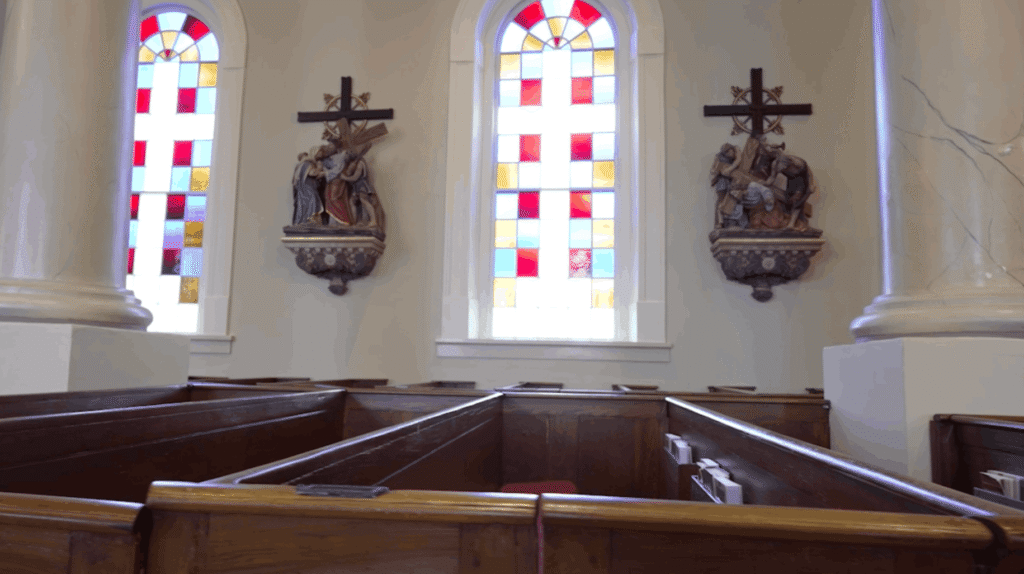
The side aisles of St. Martin de Tours feature historic box pews and a complete set of relief-style Stations of the Cross. The geometric stained glass windows reflect the church’s 19th-century ‘Roman Basilica’ architectural style.
That night Christ appeared to St. Martin in a vision wearing the beggar’s half of the cloak. Martin converted to Catholicism and became a hermit organizing Gaul’s first monastery. Today, he is the patron saint of soldiers and police officers.
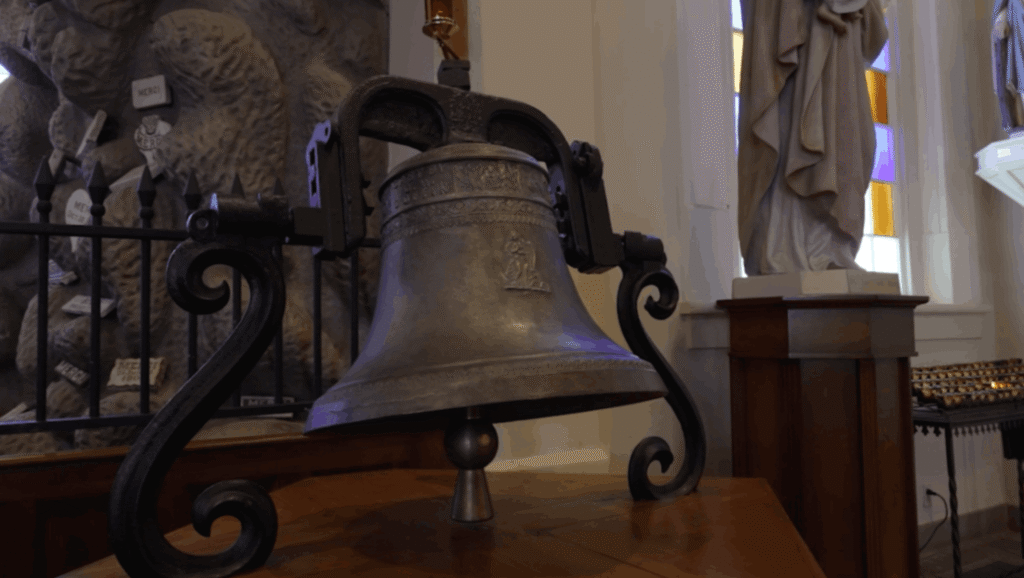
Then there is the bell, which rings every fifteen minutes. I heard it while we talked, every fifteen minutes right on cue.
The historic bell at St. Martin de Tours, an artifact from the parish’s early history. It stands as a silent witness to the generations of Acadian and Creole families who have worshipped in this sanctuary since the 18th century.
I walked outside to the small graveyard on the side of the church. There stands a bronze seated statue of Henry Wadsworth Longfellow’s heroine Evangeline.
Bronze seated statue of Henry Wadsworth.
The statue was donated by the movie actress Dolores del Rio who played the part in the film Evangeline shot in the area in 1929, and the actress posed for the statue.
Graveyard on the side of the church.
The Grotto Built by a Freed Slave
The church contains a replica of the Grotto of Lourdes constructed in the late 1870s by Pierre Martinet of St. Martinville. He was a freed slave and although he never visited the original shrine, he constructed it after studying a holy card of the site.
Father Jason Vidrine explains the history of the Lourdes Grotto to Karen LeBlanc.
When the Acadians arrived, as soon as they could they erected a church of wood in south Louisiana. One of the altars from that church in 1765 is this altar that you see here. You will see this altar in many country French churches in France, this simple wooden altar with the tabernacle. And around this altar was built the grotto of Our Lady of Lourdes. — Father Jason Vidrine
The one who designed this used chicken wire stuffed with bousillage, which is the mud and clay from the Bayou Teche and moss, and plastered it on top. Crafted locally, in homage of Our Lady of Lourdes. — Father Jason Vidrine
The interior Lourdes Grotto at St. Martin de Tours, a unique 1883 replica built by local architect Pierre Martinet. The grotto is covered with ‘ex-voto’ plaques—offerings of thanks for answered prayers—giving it a deeply personal and historic character.
He made the grotto with bousillage, a mud mixture from Bayou Teche and moss. Prayers and messages of thanks spanning decades have been posted on the grotto. The statue of Mary is similar to the one in the Grotto of Lourdes. It has endured all these years.
You realize the way in which all that we have received has come down to us through it with love, with generosity. — Father Jason Vidrine
The Ambo and the Stations
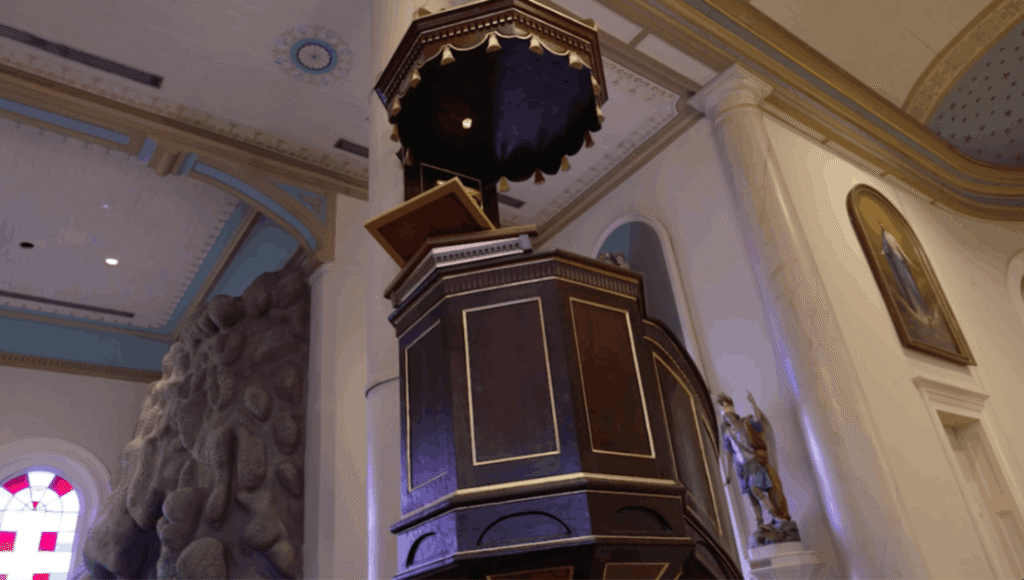
The church retains its old raised pulpit called the ambo, once necessary for the priest to deliver his sermon so his voice could carry and be heard by the congregation before amplification and electrification. The decorative pulpit is still used for Sunday masses.
The interior of St. Martin de Tours Church showcases its unique 19th-century features, including a hand-carved elevated pulpit and the massive Lourdes Grotto built into the side transept.
The church has fourteen stations of the cross crafted in France in 1904 depicting scenes of Christ’s sorrowful journey from the house of Pilate to Calvary. Father Vidrine told me they are all in French. They ordered them in the late 1800s and shipped them over.
He speaks French, and he actually performs Mass in French. On the anniversary of the deportation, every year on July 28th, he holds a special Mass.
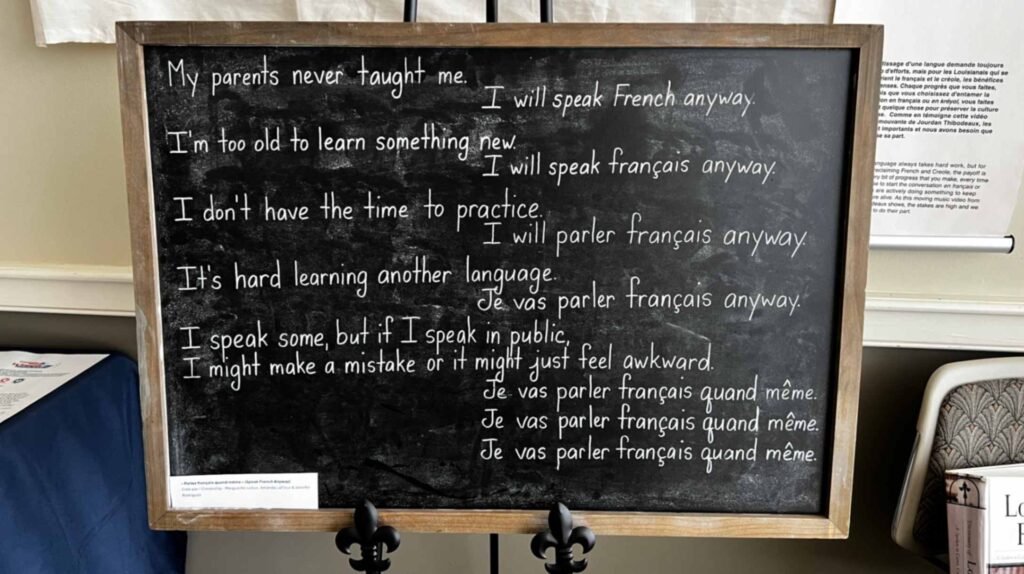
A powerful display at St. Martin de Tours illustrating the determination of the Acadian and Creole people to reclaim and speak their native French language regardless of past hardships or modern barriers.
The Heart of Acadiana
Before I left, I asked Father Vidrine if there was anything I had missed that is important to this story, keeping in mind that I wanted to create awareness and motivate people to come visit.
Father Jason Vidrine and Karen LeBlanc take in the architectural grandeur of St. Martin de Tours, the ‘Mother Church of the Acadians,’ highlighting the 19th-century craftsmanship that defines this historic Saint Martinville landmark.
Of all the different parts of what we call Acadiana, the French Triangle in Louisiana, St. Martin Parish is at the heart of it. It is from here that all of the people moved to settle in the other parts of Acadiana. And it is from here that they brought what they learned from here to the other parts. So it remains here as the center of it all, the mother Church of the people. — Father Jason Vidrine
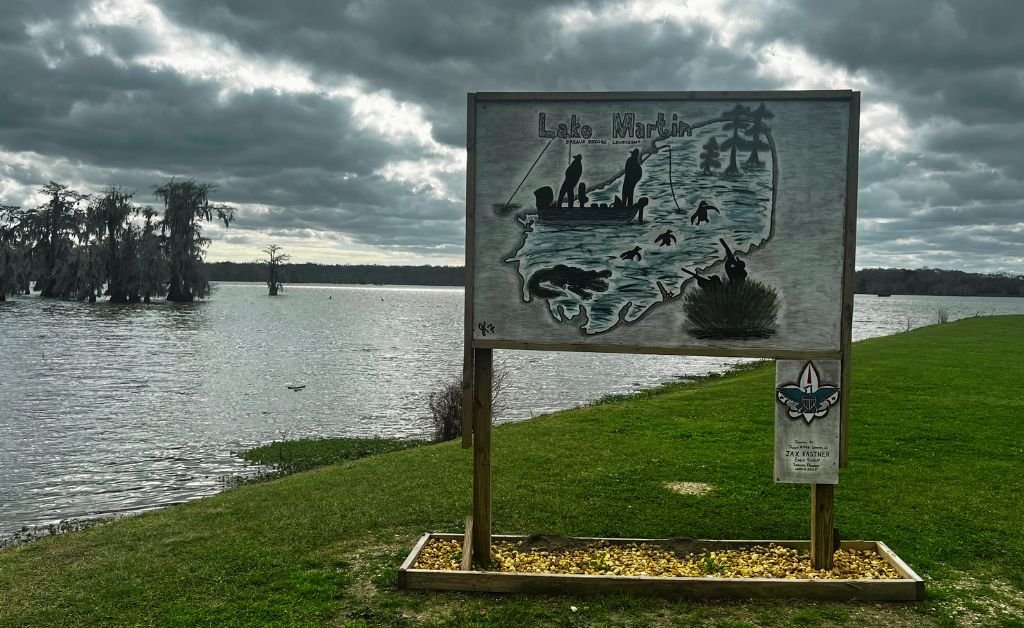
Folks visit my parish because it is a parish that offers the fullness of what we enjoy in Acadiana. The life that so many throughout the world look to and want to enjoy is found right here in St. Martin Parish. From the music to the food, to the faith that emanates from all that is done. It is a place of natural beauty, with the bayou and with St. Martin Lake, Cypress Lake. And it is also a place where one could come and just enjoy life, take it for what it is, settle down for a bit, and enjoy the peace and tranquility that captures the place. — Father Jason Vidrine
The Visitor Log
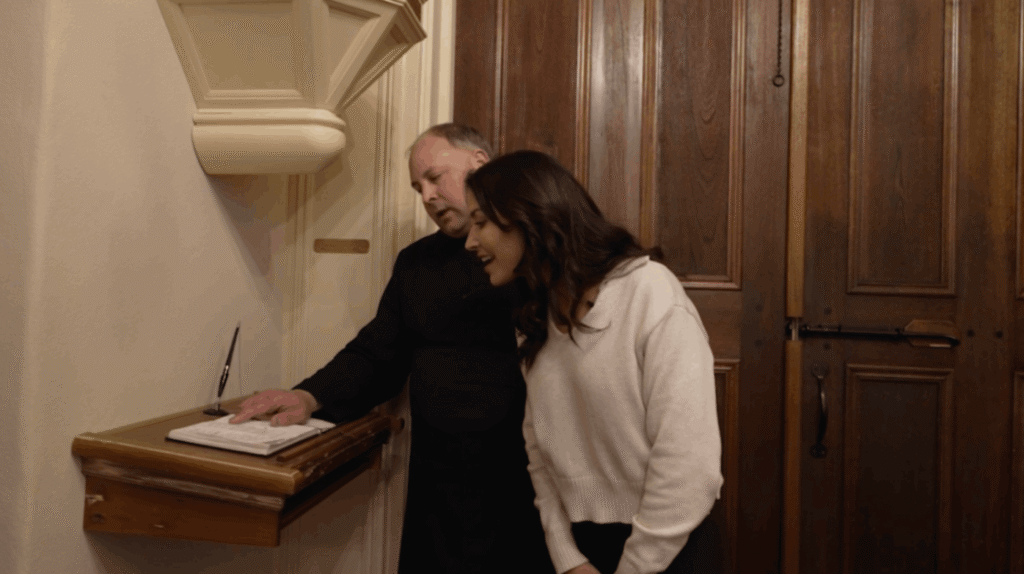
He showed me the visitor log. On that given day, December 27th, people had come from France, Canada, New York, the United Kingdom, Texas, New Iberia, Yountville, Marksville, Paris, and Tennessee. Literally on any given day, he said.
I saw Brazil in the log. Wow, Brazil, look at that, I thought to myself.
I signed the book myself and wrote just from Baton Rouge, but that is okay. Everyone is welcome to St. Martinville.
Father Jason Vidrine and Karen LeBlanc examine a historic ledger at the entrance of St. Martin de Tours. These records often document the deep genealogical roots of the local Acadian and Creole families.
Father Vidrine told me the office gets genealogical inquiries constantly. People call for sacramental records because they know that if you carry an Acadian name, your ancestors were here, either married, died, born, or baptized at this church.
I thought about my own name, LeBlanc. Somewhere in those records, probably, my own people.
I came as a LeBlanc looking for my roots.
Plan Your Visit in Saint Martin de Tours
Saint Martin de Tours Catholic Church is located in St. Martinville, Louisiana. The church is open to visitors daily, and Sunday masses are held in the morning. The church also hosts a special Mass in French every year on July 28th, the anniversary of the Acadian deportation.
While visiting, see the grotto, the ambo, and the 1765 altar around which the grotto was built. The fourteen stations of the cross, crafted in France in 1904, are all in French. Bring a pen to sign the guest book. The small graveyard on the side of the church holds the bronze Evangeline statue.
For genealogical research, the church office holds sacramental records dating back to 1765, so call ahead to inquire about access.